Migration Guide

Migrating Existing Wooden Frames into QuickFrame

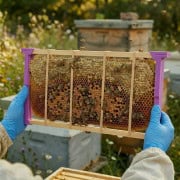
...BEFORE
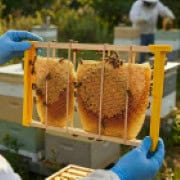
...AFTER
...EASY PEASY
The Concept
You've got frames full of drawn comb, brood, and honey that you want to keep. QuickFrame migration lets you transfer that existing work into a new frame—no waste, no starting from scratch.  It's a simple, bee-friendly process that works with nature instead of against it.
Migrate existing comb into QuickFrame:
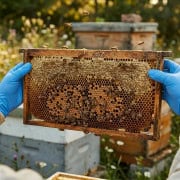
  • Cut out the comb — Using your hive tool or knife, carefully cut the entire comb from your old wooden frame. Work around the edges first, then support the comb from underneath as you free it from the top and bottom bars. (This is similar to a wild hive "cut-out" if you've done that before.)
  • Insert into the assembled QuickFrame — Place the cut comb into the QuickFrame, positioning it into the top and bottom bar cavities.  The fit should be snug but not forced.  Don't worry if it's a little loose.
  • Secure temporarily with rubber bands — Wrap rubber bands vertically around the frame to hold the comb in place.  Use 3–4 bands depending on frame depth. Some beekeepers also use an "X" pattern from corner to corner.  The bands are temporary — they'll be removed naturally by the bees.  FYI: #33 rubber bands are the commonly recommended size.
  • Let the bees finish the job — Return the frame to the hive.
    Over the next few days to a week, the bees will:
  • Fill any gaps around the comb with fresh wax and propolis.
  • Solidify the comb into place naturally.
  • Gnaw through and remove the rubber bands during their routine hive cleaning.
No intervention needed after that — nature handles it.
FAQ — Migration & Comb Transfer

Three big reasons:

  1. Cost — A drawn frame with comb is worth $8–15 in labor and materials. Why throw that away?
  2. Time — Bees take weeks or months to draw out new comb.
                   Migration gets you back to productivity immediately.
  3. Sustainability — Reusing existing comb is better for the bees and the environment.

Yes.  The rubber bands hold it securely while the bees work.  The bees' natural instinct is to fill gaps and strengthen comb, so they'll quickly stabilize it.  You might notice the comb shift slightly in the first day or two as the bees adjust, but it won't fall out.

Absolutely.  In fact, the bees are more motivated to work on a frame with brood present.  They'll care for the brood normally while reinforcing the comb around it.  Just be gentle when cutting and moving — support the frame well so you don't jostle the larvae.

Small cracks or breaks heal quickly — bees will seal them with propolis and fresh wax.  If you accidentally crush a section of brood cells, the bees will clean it out and rebuild.  Large damage (like severing the comb in half) makes migration impractical; in that case, scrape the comb and use the frame as-is for them to rebuild.

Rubber bands are cheap, reusable, non-toxic, and bees know exactly how to remove them.  The bees will chew through them naturally over about a week—it's part of their normal cleanup behavior.  You don't have to monitor or remove anything manually.

Yes, as long as the comb is still intact and disease-free.

If you're concerned about disease (foulbrood, etc.), it's safer to cut and discard the old comb and let the bees build fresh comb in the QuickFrame.  But if you're confident the old comb is healthy, migration is a great way to preserve it.

Small gaps are fine — even encouraged.  The bees will fill them in with new wax, actually creating a stronger, more integrated frame than you started with.  Large gaps (more than ¼") might need a thin wedge or additional support, but in most cases, bees are excellent at gap-filling.

Small colonies can migrate frames, but they work slower.  With a smaller population, it might take 2–3 weeks for full stabilization instead of a week. If the colony is very weak (under 3 frames of bees), consider waiting until it's stronger, or migrate just one frame at a time so you're not overwhelming them.

Yes, but be prepared for some spillage as you work and as the bees rearrange things.  If the frame is very heavy with honey, consider extracting some first to make it easier to handle.  A frame that's 60% honey and 40% empty comb is ideal for migration.

Start with a few (2–4 per hive box) if you're new to the process.  This lets the bees focus their efforts and doesn't disrupt the hive too much.  If your colony is strong and it's early season, you could migrate more.  Experienced keepers often migrate entire boxes at once, but take it slow the first time.

Most frames stabilize within 3–5 days.  By day 7–10, the bees will have usually finished reinforcing the comb and removed the rubber bands.  In cool weather or with slower colonies, it might take up to 2 weeks.  There's no rush — the frame is safe to work with even while the bees are still finishing.
QuickFrame Logo - Transparent
©2024-2026 QuickFrame - All Rights Reserved

Join the MEGA Waitlist

Be first in line when MEGA ships in Summer 2026.

It's up to you: Convert those wooden frames before winter or get ready for next Spring change-over to MEGA now.

Production has begun. We'll email you the moment inventory is available, plus the bonus of a waitlist-only early-bird pricing.

FreezeFrameBees.com
Our complimentary sister product:

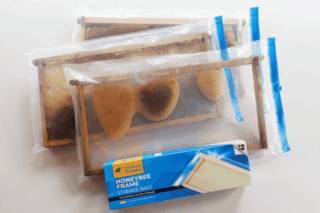
FreezeFrame Bags

...are reusable storage bags specifically designed for honey bee frame storage, with a primary focus on freezing frames prior to long-term dry storage.

Get in Touch with Us

If you have questions or comments, please reach out to us. We like to hear from Customers about their QuickFrame uses and ideas.
QuickFrame

Subscribe to News & Event Updates

From time to time we send out News and Event information. We do not sell or share your information with any 3rd parties.